Launch offer — valid today only

📄 Digital book in PDF · read it on your phone or print it

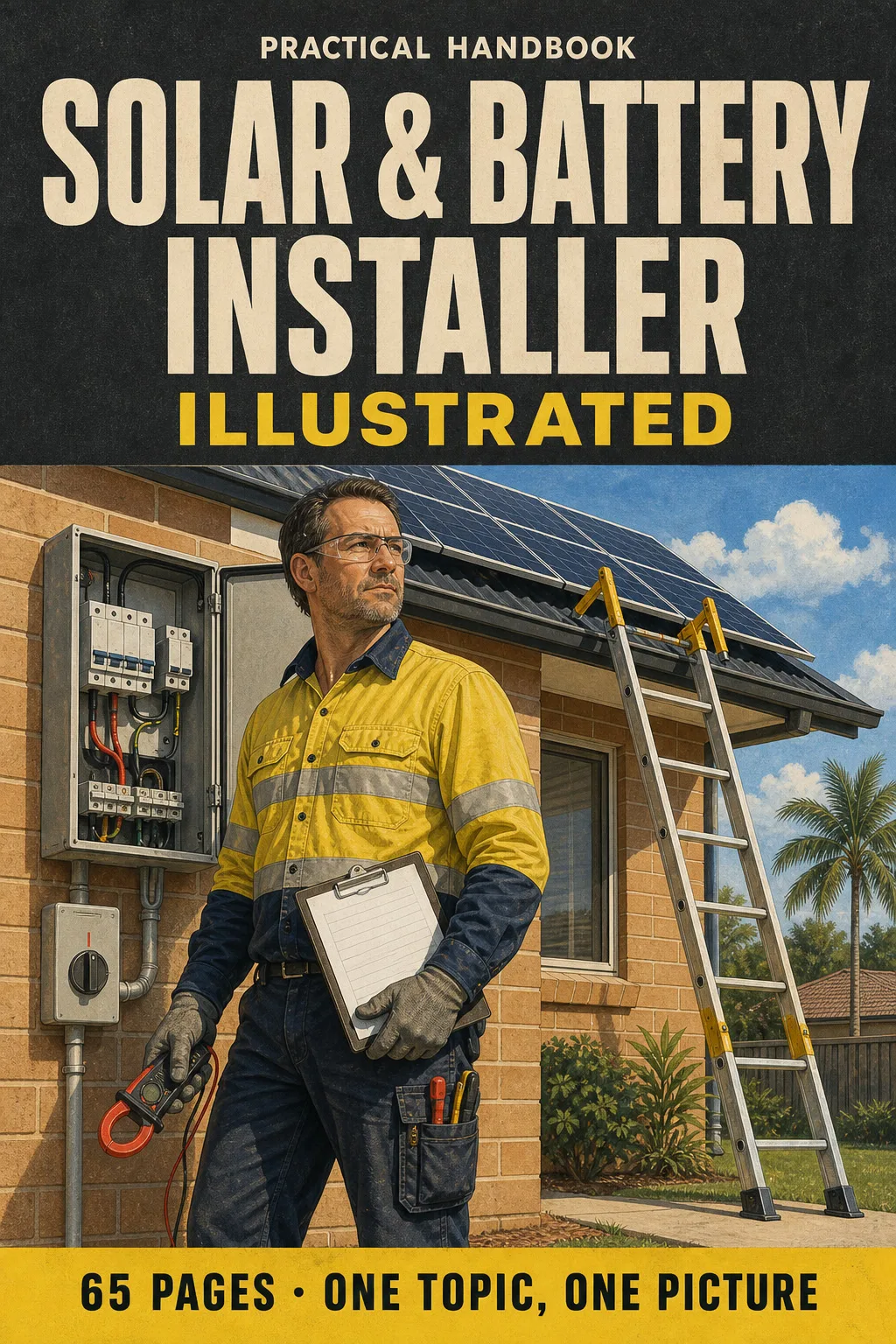
Solar and Battery Installs in Drawings: Size Every String in the Same 5 Steps One Rule on Every Page

Strings on a cold morning, DC isolators, earthing, inverter settings, AC voltage rise, where a battery can go, sizing from the bill and commissioning. Every topic has its own page: the drawing first, then what you need to remember. 65 illustrated pages.

START STUDYING THIS WAY

🔒 Secure checkout · PDF by email · 30-day guarantee

Every topic, its own pageEvery rule drawn, with the explanation right beside it
65 illustrated pages8 parts, from one system in six links to the checklist before you leave the site
Up-to-date sourcesAS/NZS 3000, AS/NZS 5033, AS/NZS 4777 and AS/NZS 5139 (current editions)
PDF by emailFormat

Look Inside the Book

Every page has one big drawing and a box with the numbers and steps you need to know:

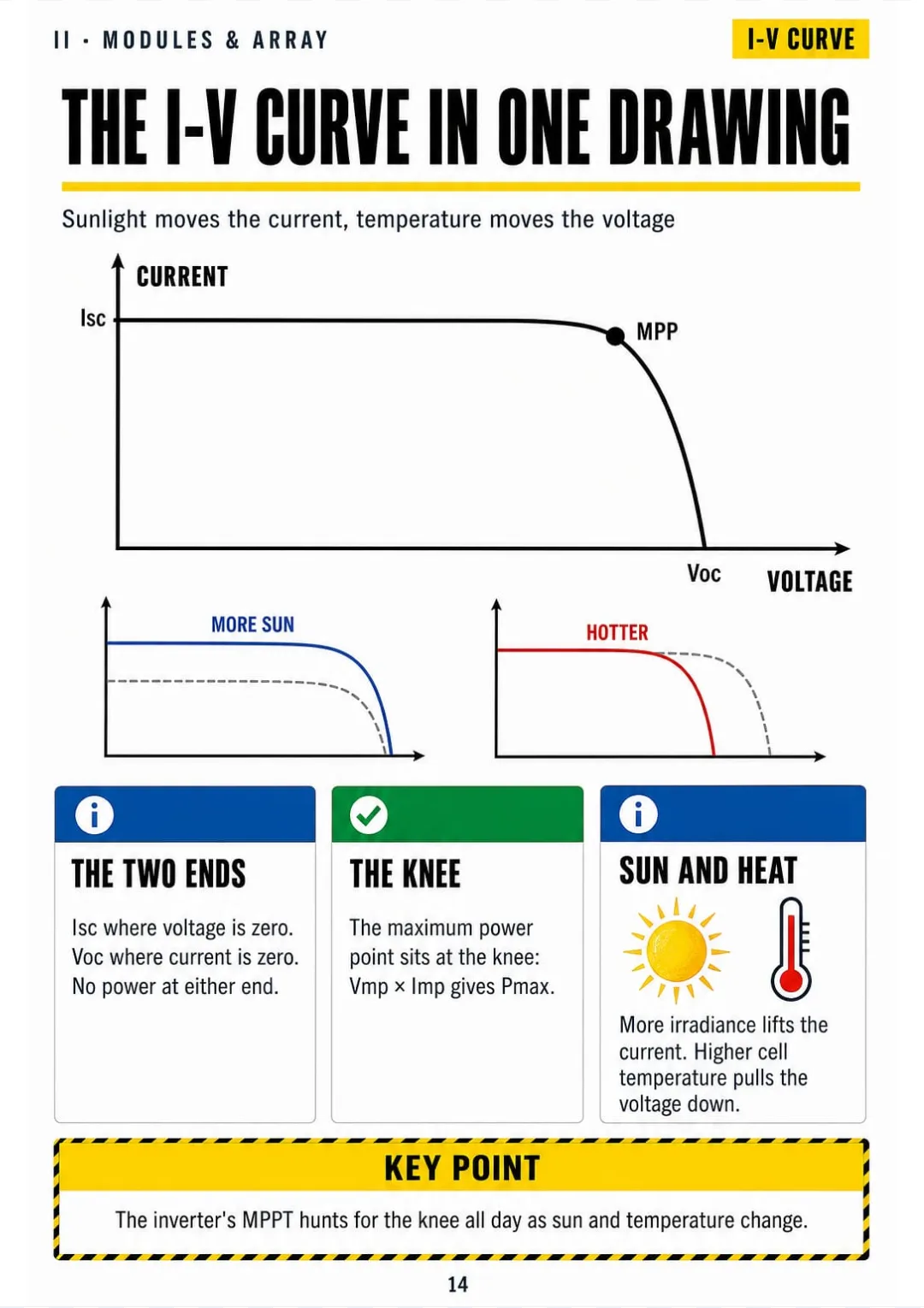
Isc on one axis, Voc on the other, maximum power at the knee
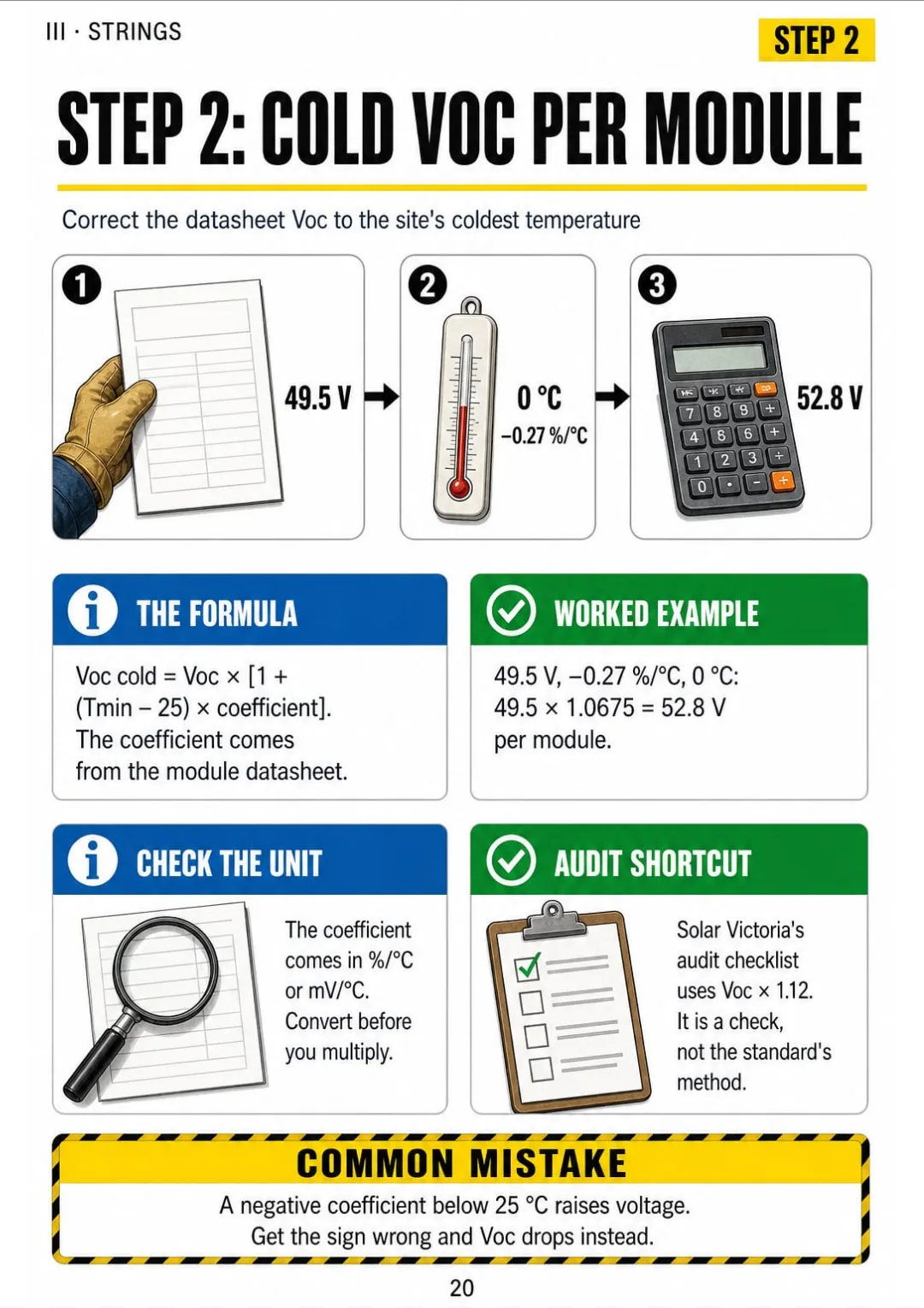
49.5 V × [1 + (0 − 25) × −0.27 %] = 52.8 V per module
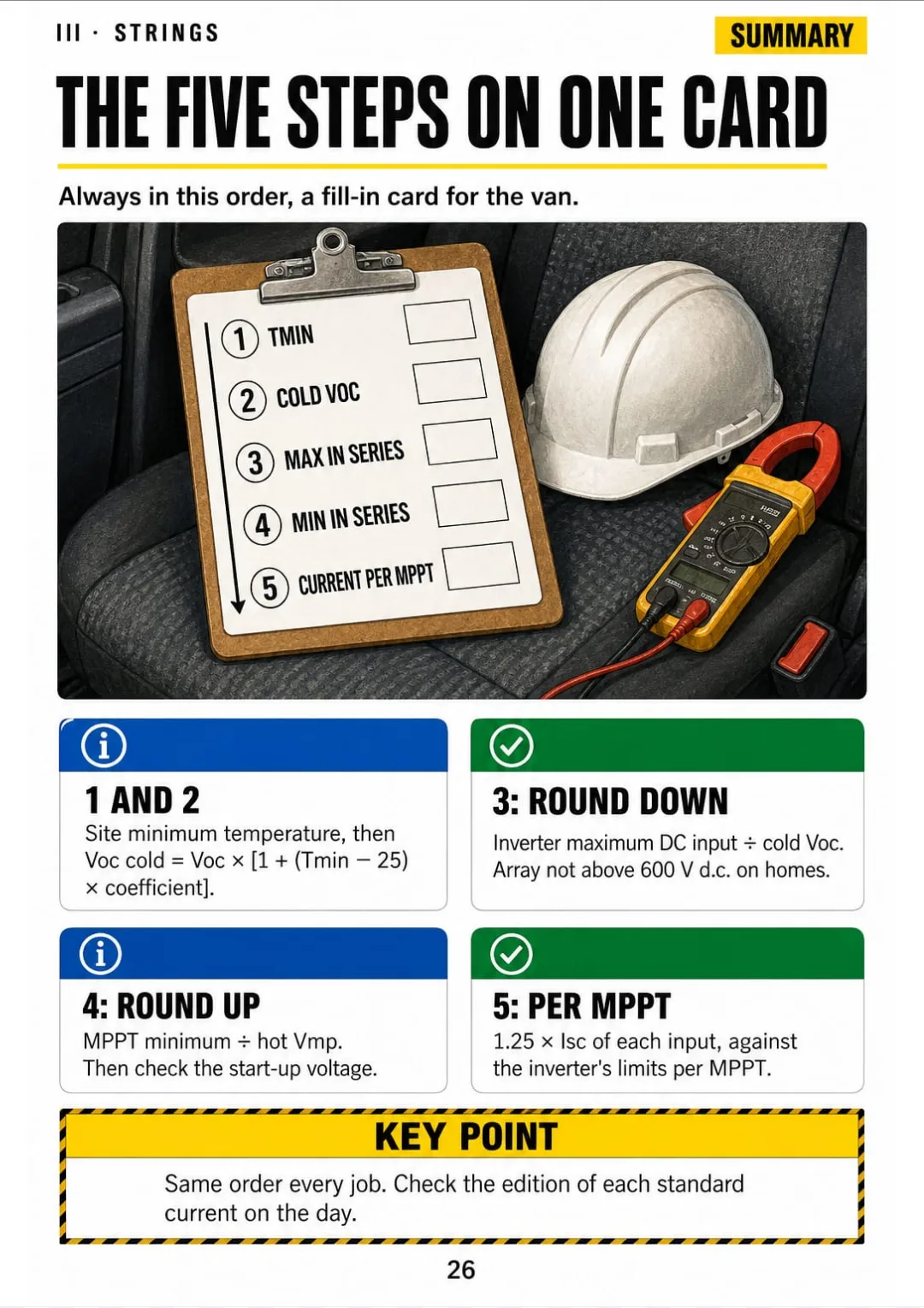
Tmin → cold Voc → max in series → min in series → current per MPPT
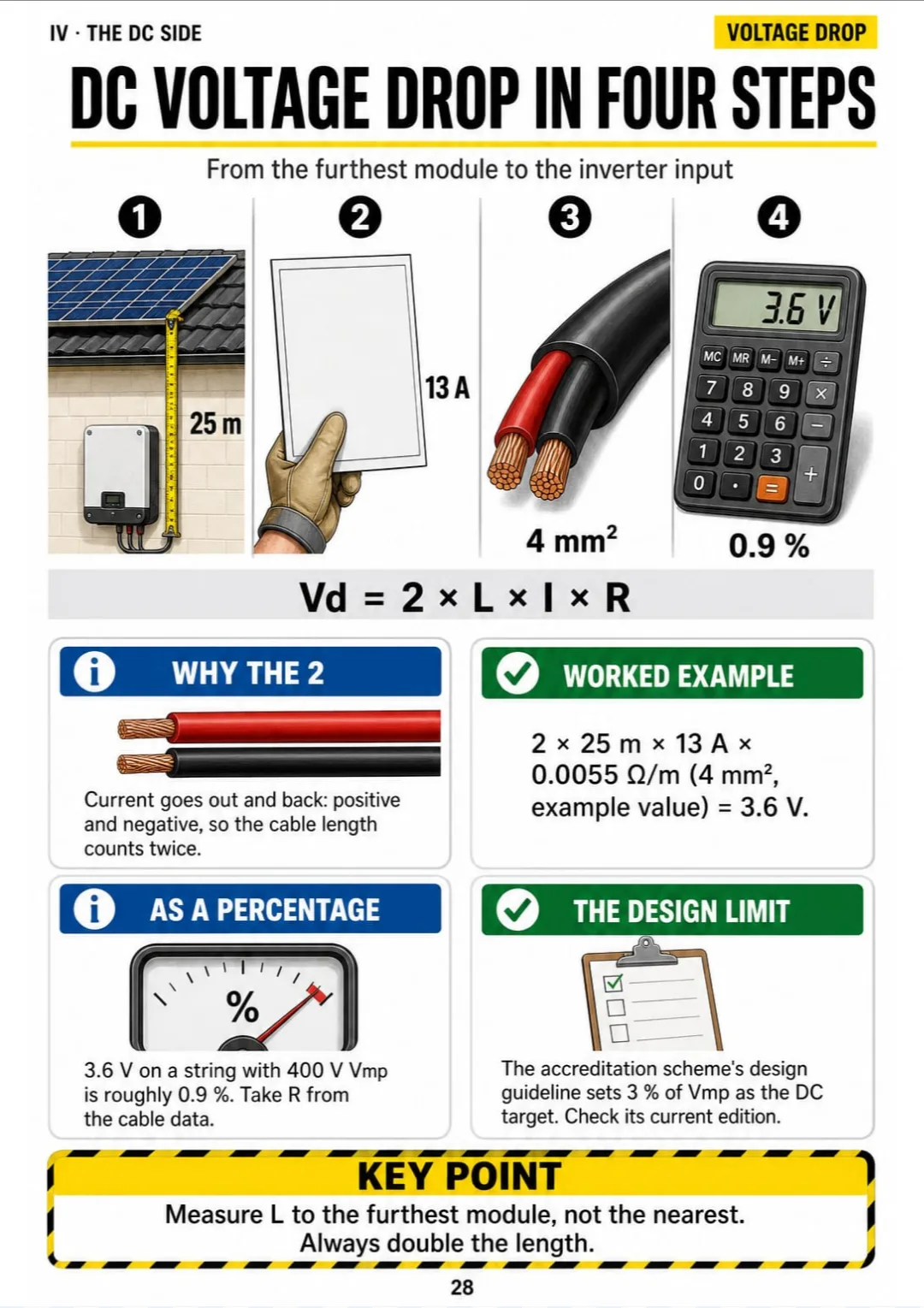
25 m at 13 A on 4 mm² ≈ 3.6 V, about 0.9 % of a 400 V string.
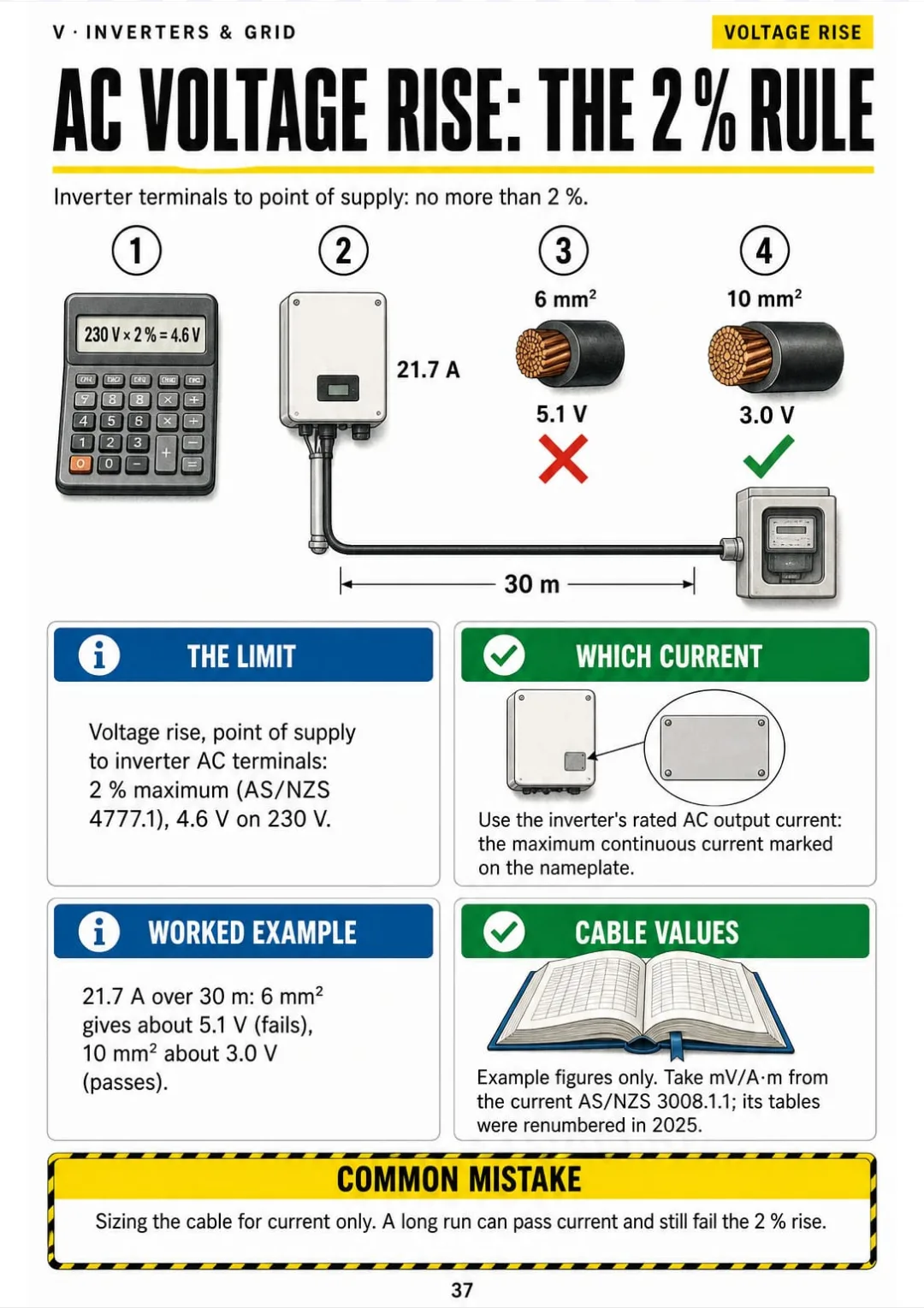
2 % of 230 V is 4.6 V: 6 mm² fails, 10 mm² passes
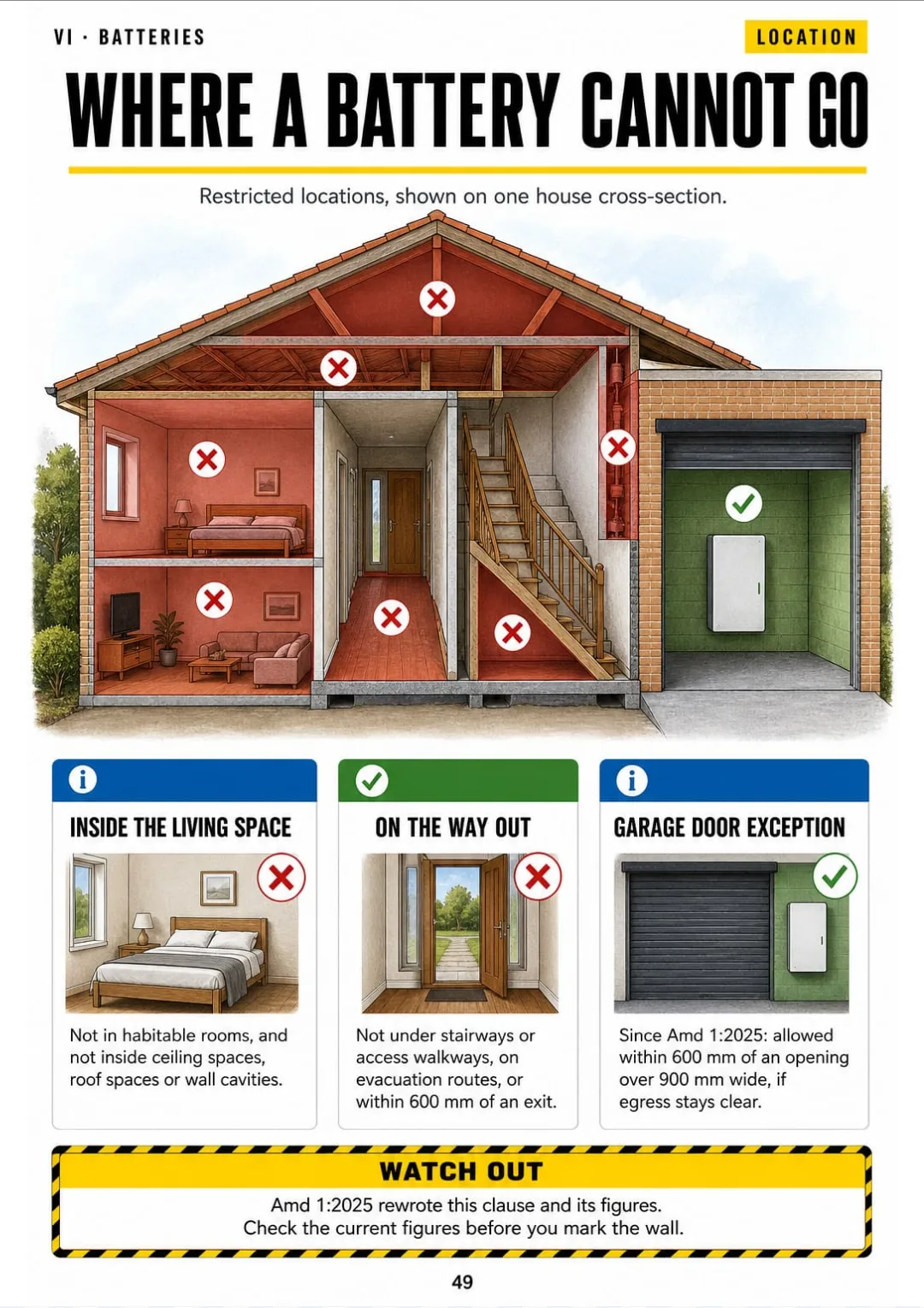
Restricted locations: habitable rooms, ceiling and roof spaces, cavities, exits
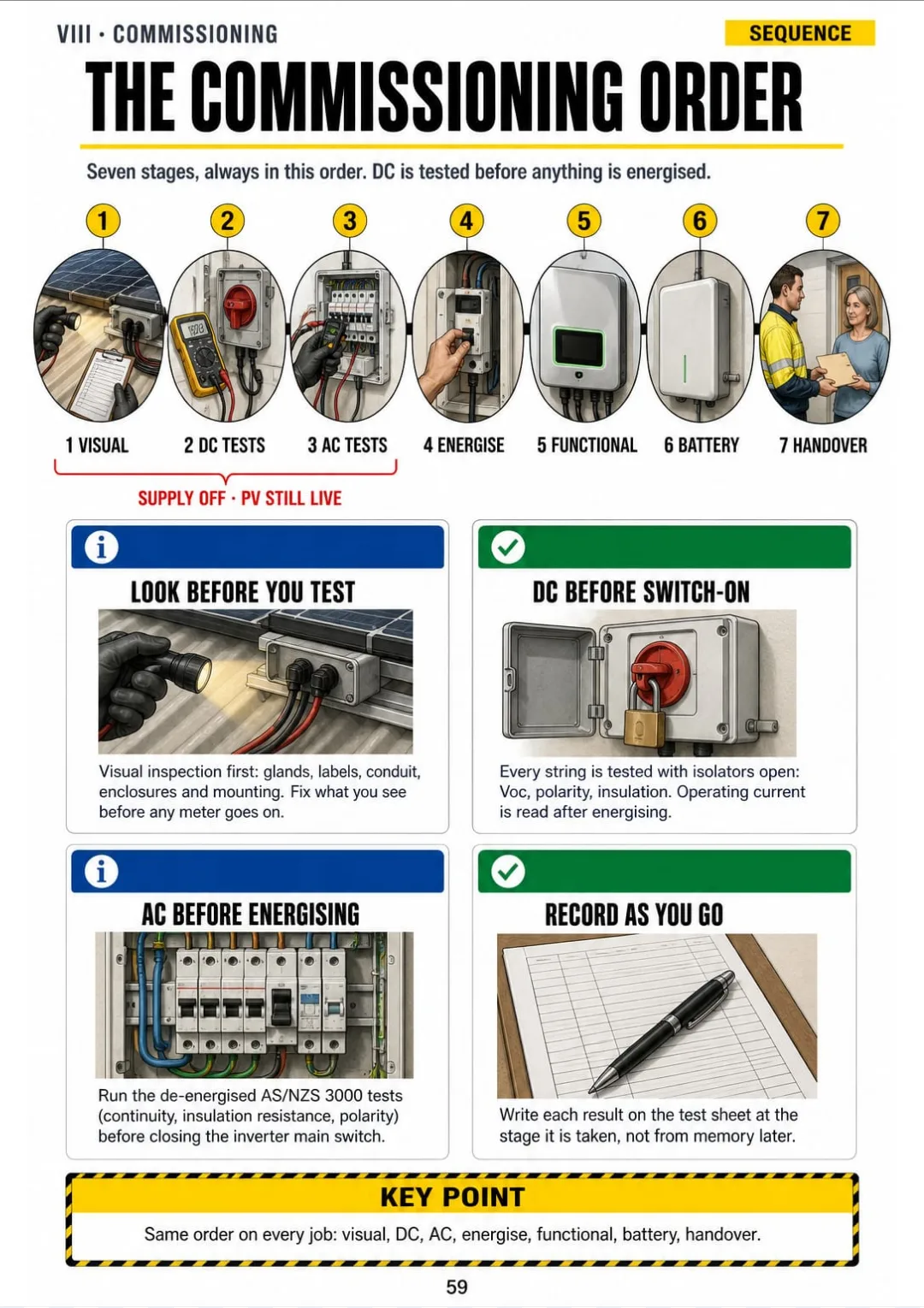
Visual → DC → AC → energise → functional → battery → handover, every time.
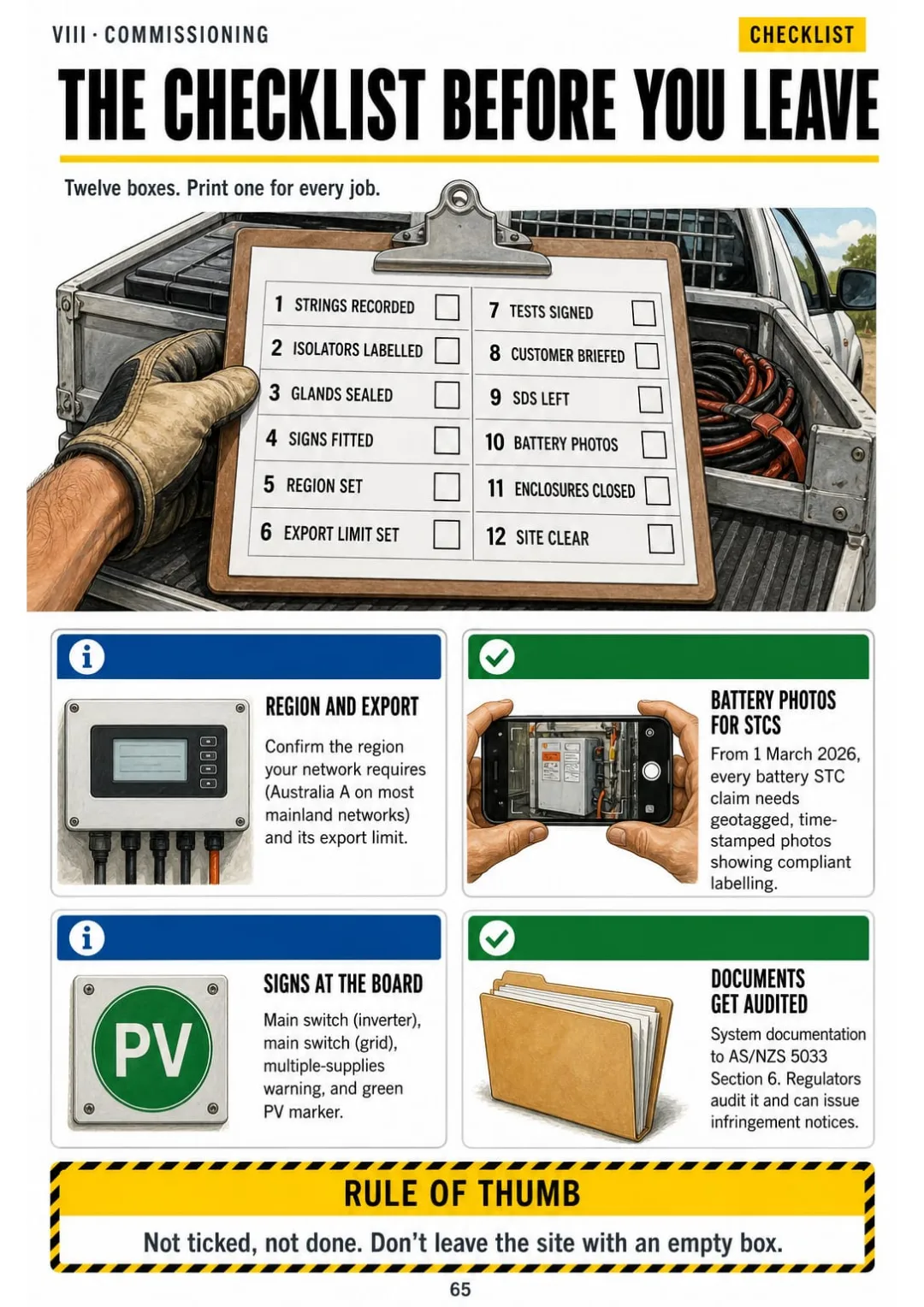
Twelve-box exit checklist: strings, labels, glands, signs, region, export, tests, briefing.

Swipe to see more →

These are real pages from the book. The table of contents is the full one: 8 parts and 61 topics.

The Problem Isn't You. It's How It Was Explained to You.

It's 9 pm at the kitchen table. Module datasheet on one side, inverter datasheet on the other, and you can't remember which step comes first: cold Voc, or modules in series?

The course module covers string sizing in four pages of paragraphs, with the minimum string length tucked halfway down. Five steps written as one long block don't come back to you the next morning.

Tmin → cold Voc → max in series → min in series → current per MPPT

In this book, string sizing is one card: Tmin → cold Voc → max in series → min in series → current per MPPT, left to right, with a worked number under each box.

Every other topic gets its own page the same way: DC voltage drop, the 2 % AC rise rule, earthing the array, where a battery can't go, the commissioning order.

You look at the card, run the numbers in order and design the string without reopening the manual.

COMPARE FOR YOURSELF

The Same Topic, Two Ways to Study It

THIS
  • The manual: line after line
  • String sizing explained only in words
  • You walk into the assessment unsure
Open-circuit voltage as stated on the module datasheet is determined under Standard Test Conditions, namely a cell temperature of 25 °C and irradiance of 1000 W/m². As cell temperature decreases, open-circuit voltage increases in accordance with the module's voltage temperature coefficient. The designer shall therefore calculate the corrected open-circuit voltage at the lowest expected temperature for the site, applying the coefficient to the difference from 25 °C, and shall ensure the resulting value, multiplied by the number of modules in series, does not exceed the inverter's maximum input voltage.
FOR THIS
  • Cold Voc in one drawing
  • The numbers in a box: 49.5 V → 52.8 V
  • You see it and you get it
49.5 V × [1 + (0 − 25) × −0.27 %] = 52.8 V per module
CONTENTS

Take a Look at the 8 Parts and 61 Topics

The whole system, modules and the array, strings, the DC side, inverters and the grid, batteries, design from the bill and the roof, and commissioning: 65 pages, all illustrated

IThe Whole System in One Chain · pp. 5-10
  1. One system, six links
  2. Which standard covers which link
  3. From licence to accreditation
  4. DC is not AC
  5. Voltage bands on a PV job
  6. Grid-connected, hybrid or off-grid
IIModules and the Array · pp. 11-17
  1. Reading a module datasheet
  2. STC versus a real Australian roof
  3. The three temperature coefficients
  4. The I-V curve on one drawing
  5. Orientation and tilt in the southern hemisphere
  6. Shading and bypass diodes
  7. Mounting for the site's wind region
IIIStrings: Sizing in Volts and Amps · pp. 18-26
  1. Series adds volts, parallel adds amps
  2. Step 1: find the coldest morning
  3. Step 2: cold Voc per module
  4. Step 3: maximum modules in series
  5. Step 4: hot Vmp against the MPPT minimum
  6. Step 5: current into each MPPT
  7. Parallel strings and reverse current
  8. Matching strings on one MPPT
  9. The five steps on one card
IVThe DC Side: Cables, Isolation, Earthing · pp. 27-34
  1. Choosing PV cable
  2. DC voltage drop in four steps
  3. PV connectors: no cross-mating
  4. Routing DC cable on the roof and inside
  5. The DC isolator at the inverter
  6. Keeping water out of DC enclosures
  7. Earthing and bonding the array
  8. Surge protection: when and where
VInverters and the Grid Connection · pp. 35-43
  1. String, hybrid, micro or optimiser
  2. Inverter sizing and the DC:AC ratio
  3. AC voltage rise: the 2 % rule
  4. The inverter at the switchboard
  5. Approved inverter, correct region setting
  6. Volt-var and volt-watt in one drawing
  7. Network approval and export limits
  8. Signs and labels at the switchboard
  9. Single-phase or three-phase sites
VIBatteries · pp. 44-53
  1. kWh, kW and usable capacity
  2. LFP, NMC and lead-acid
  3. AC-coupled or DC-coupled
  4. The six battery hazards
  5. Decisive voltage classes A, B and C
  6. Where a battery cannot go
  7. Clearances around the battery
  8. Barriers, garages and weather
  9. Sizing a battery from evening use
  10. Backup circuits and changeover
VIIDesign from the Bill and the Roof · pp. 54-58
  1. Reading the customer's bill
  2. Array size from daily use
  3. Laying out the roof
  4. Roof safety before the first panel
  5. The paperwork chain
VIIICommissioning, Handover and Review · pp. 59-65
  1. The commissioning order
  2. DC tests string by string
  3. Insulation resistance on the array
  4. AC tests under AS/NZS 3000
  5. Anti-islanding and battery functional checks
  6. Handover to the customer
  7. The checklist before you leave the site

One Page, One Topic, All Clear

Think of it this way:

It's the week before your assessment and a practice question asks for the maximum modules in series on a 0 °C morning.

You open the cold Voc page and see one module, one thermometer and one line of maths: 49.5 V × [1 + (0 − 25) × −0.27 %] = 52.8 V.

2 % of 230 V is 4.6 V: 6 mm² fails, 10 mm² passes

Same with DC voltage drop, AC voltage rise, where a battery can't go and the commissioning order: each one on its own page.

Solar & Battery Installer Illustrated is 8 parts and 61 topics, all drawn, plus a book of exam-style questions and a book of 15 install mistakes to practise with.

What you see drawn, you don't have to memorize.

What's Inside Solar & Battery Installer Illustrated:

Ipp. 5-10

The Whole System in One Chain

Start with the big picture: see the whole system as six links from panel to battery and know which standard covers each one, plus the path from licence to accreditation, DC versus AC, voltage bands and system types.

IIpp. 11-17

Modules and the Array

Reading a module datasheet, STC versus a real Australian roof, temperature coefficients, the I-V curve, orientation and tilt, shading and mounting for the wind region.

IIIpp. 18-26

Strings: Sizing in Volts and Amps

Series and parallel, then string sizing in five steps: coldest morning, cold Voc, max and min in series, current per MPPT, all on one card.

IVpp. 27-34

The DC Side: Cables, Isolation, Earthing

PV cable, DC voltage drop in four steps, connectors, cable routing, the DC isolator, keeping water out, earthing the array and surge protection.

Vpp. 35-43

Inverters and the Grid Connection

Inverter types, the DC:AC ratio, AC voltage rise and the 2 % rule, region settings, volt-var and volt-watt, export limits, signs and three-phase sites.

VIpp. 44-53

Batteries

kWh versus kW, battery chemistries, AC or DC coupling, the six hazards, voltage classes, restricted locations, clearances, sizing from evening use and backup circuits.

VIIpp. 54-58

Design from the Bill and the Roof

Reading the customer's bill, array size from daily use, laying out the roof, roof safety and the paperwork chain.

VIIIpp. 59-65

Commissioning, Handover and Review

Leave every site knowing nothing was skipped: the commissioning order, DC tests string by string, insulation resistance, AC tests, anti-islanding and battery checks, handover and a twelve-box exit checklist.

At the end of the book: The five string-sizing steps on one card and a twelve-box exit checklist.
Plus: 2 Free Books

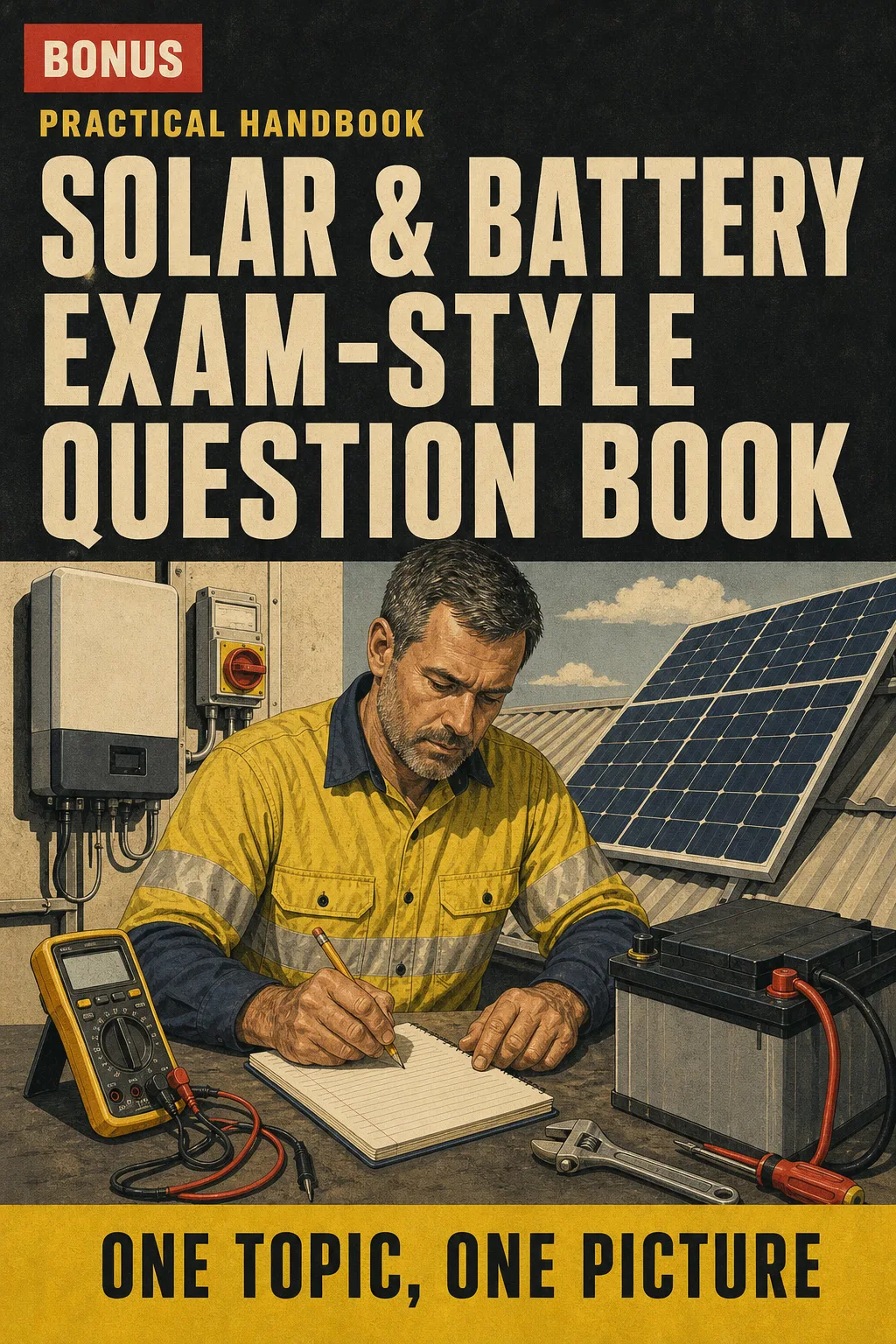
Solar & Battery Exam-Style Question Book

BONUS 1: «Solar & Battery Exam-Style Question Book»

Value on its own: US$ 17.90

Test yourself on strings, isolators, earthing, batteries and commissioning with exam-style questions and a worked answer for each, so you know where you stand before your assessment.

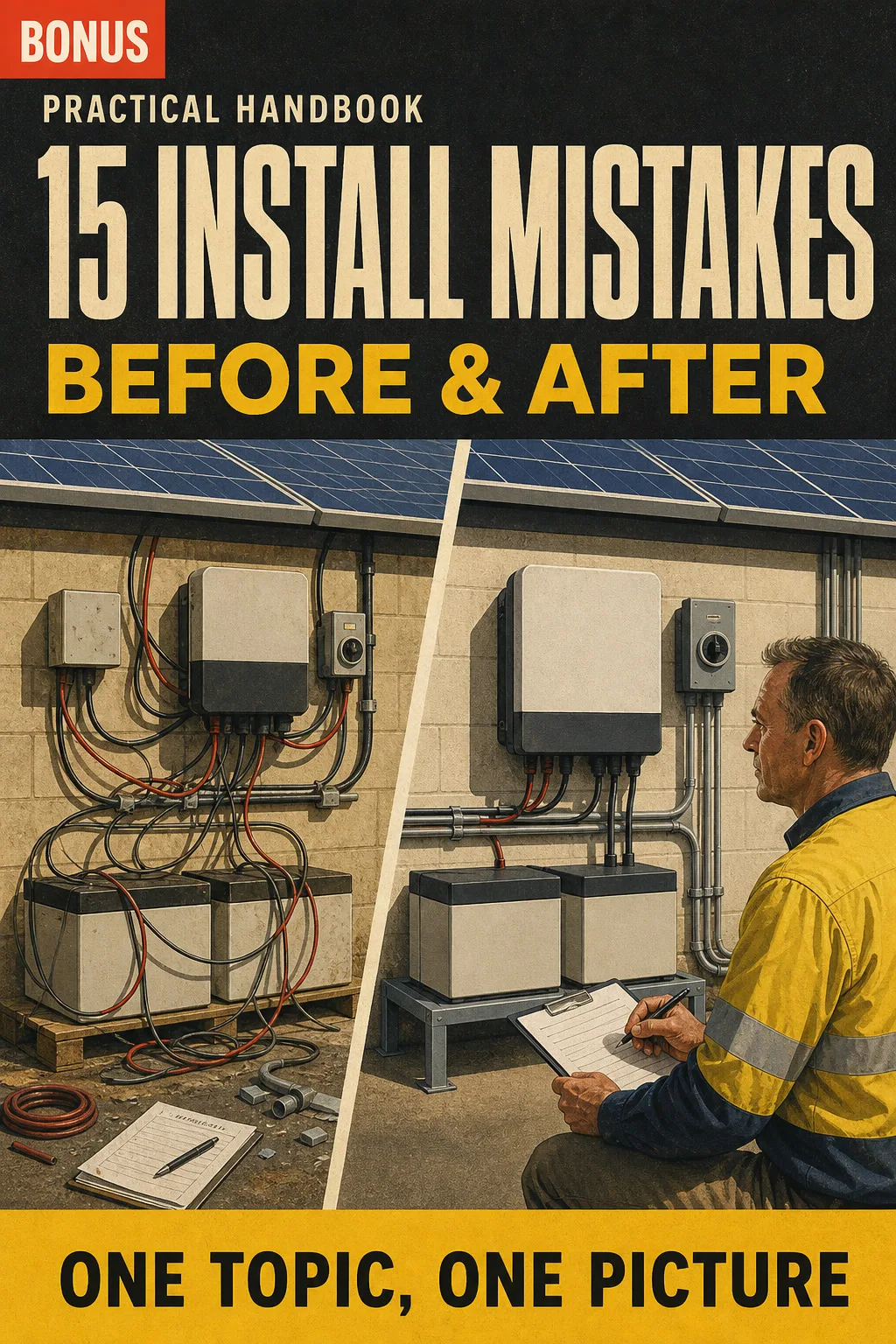
15 Install Mistakes: Before & After

BONUS 2: «15 Install Mistakes: Before & After»

Value on its own: US$ 14.90

See the most frequent solar and battery install mistakes drawn side by side with the correct version, so you spot them on the roof before an inspector does.

Solar & Battery Installer Illustrated with 2 Free Books

  • Solar & Battery Installer Illustrated: 65 illustrated pagesUS$ 63
  • BONUS 1: Solar & Battery Exam-Style Question BookUS$ 17.90
  • BONUS 2: 15 Install Mistakes: Before & AfterUS$ 14.90
  • High-resolution PDF to printIncluded
Total value US$ 95.80
YOUR PRICE:
US$ 27
You save US$ 68.80
YES, I WANT SOLAR & BATTERY INSTALLER ILLUSTRATED FOR US$ 27

📄 This is a digital PDF book sent to your email: nothing is printed or shipped.

Secure purchaseEncrypted payment30-day guarantee

PDF by email: We email you Solar & Battery Installer Illustrated as a PDF, together with the two free books. It's a single payment: no installments, no extra charges.

Who This Book Is For

You're doing the accreditation course

You're doing the accreditation course

Each module topic gets one page with one drawing, so what you study at night is still there the next weekend.

Your assessment is close

Your assessment is close

String sizing, voltage drop and battery locations in the same steps every time, plus exam-style questions to see where you stand.

You're already doing solar jobs

You're already doing solar jobs

A printable book for the ute: check the commissioning order or the battery clearances before each job.

Everything You Get Today

US$ 95.80US$ 27
YES, I WANT SOLAR & BATTERY INSTALLER ILLUSTRATED FOR US$ 27

📄 This is a digital PDF book sent to your email: nothing is printed or shipped.

30DAYS
GUARANTEE

30-Day Guarantee

Try Solar & Battery Installer Illustrated for 30 days, bonus books included.

We refund everything if the file won't open, if the book isn't what you see here, if you were charged twice or if the email doesn't arrive. Just email us.

You pay once. No subscriptions.

Frequently Asked Questions

Is it for me if I'm already a licensed electrician with years on the tools?

Yes. It assumes you know AC work and focuses on the solar and battery side: strings, DC protection, inverters, batteries and commissioning, in order.

Where does the content come from?

Written for Australian sites: AS/NZS 3000, AS/NZS 5033, AS/NZS 4777.1, AS/NZS 5139 and AS/NZS 3008.1.1 in their current editions, plus the accreditation scheme's design and install guidelines. 230 V, Australian wind regions and Australian site temperatures. Explained in our own words and drawings, never copied from the standards. If a standard is amended, check the value against your copy.

Is this official material?

No. It's independent study material, not affiliated with or endorsed by any accreditation body, regulator or standards organisation.

Does it replace the accreditation course?

No. It's a revision book that goes alongside the mandatory accreditation course, your licence, the standards and the manufacturer's instructions. It doesn't give you a certificate, a credit or accreditation: that comes only from your course and the accreditation scheme.

Are the practice questions the ones in the exam?

No. They're written for this book in an exam style, so you can test yourself before your assessment.

When and how do I get it?

The book and the 2 bonus books arrive as PDFs by email, at the address you enter at checkout.

Do I have to pay every month?

No. It's a one-off payment.

Can I have it on paper?

It's a PDF, not a printed book. It prints well on A4 at home or at a print shop, so you can keep a copy in the ute.

How does the refund work?

You have 30 days. We refund everything if the file won't open, if the book isn't what you see on this page, if you were charged twice or if the email doesn't arrive: just email us.

Before You Close This Page

No more rereading clauses that don't stick.

Cold Voc: you see it drawn and it's done.

You walk into your assessment knowing where everything is.

Drawings make studying faster.

The book is right below.

One-time payment: US$ 27 · Guarantee: 30 days · PDF by email

YES, I WANT SOLAR & BATTERY INSTALLER ILLUSTRATED FOR US$ 27

📄 This is a digital PDF book sent to your email: nothing is printed or shipped.